
Written by Anja Heid, Employability Adviser
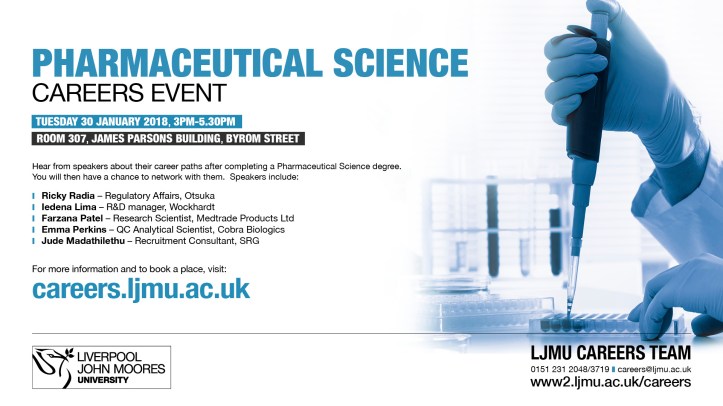
Five graduates from LJMU’s ACAPS (Applied Chemical and Pharmaceutical Sciences) degree – now BSc (Hons) Pharmaceutical Science – visited us on Tuesday, 30th January 2018, to connect with current students and shared their experiences of job-hunting and working in the pharmaceutical industry:
- Iedena Lima, who graduated in 2009, now works as an R&D manager at Wockhardt in Wrexham after first working at the company during her sandwich placement, and then re-joining Wockhardt as a graduate, gaining experience as a formulation scientist and formulation development manager. There’s a little LJMU outpost at Wockhardt, with three other LJMU ACAPS graduates in Iedena’s team!
- Ricky Radia began his career in regulatory affairs after graduating in 2006, and gained experience at AstraZeneca, GSK, Gillette and LEO Pharma before taking up his current role as senior manager global regulatory affairs at Otsuka.
- Farzana Patel’s experience from her sandwich placement at GSK and first graduate role in 2015 as a research scientist at Convatec has enabled her to secure a position as research scientist at Medtrade Products Ltd.
- Emma Perkins also graduated in 2015 and is enjoying her role as a QC analytical scientist at Cobra Biologics, which is currently undergoing an exciting £15m expansion of its gene therapy manufacturing operations.
- Jude Madathilethu gained experience as an R&D chemist and QC analyst before moving into his new commercial role as a recruitment consultant at SRG, a recruitment agency specialising in the science, pharmaceutical and chemical sectors.
(If you’d like to find out more about the speakers’ career paths and current employers, you can download copies of their presentation slides from the Pharmaceutical Science programme site on Canvas.)
For further information about careers in the pharmaceutical sector and working in a laboratory setting, download a copy of the Career Planning Guide for the School of Pharmacy and Biomolecular Sciences and our mini-guide on Laboratory Work Experience.
Missed the presentations? Fear not! Anja Heid, one of the Employability Advisers in the Careers Team, has summarised their collective top ten tips.
- Understand your chosen sector and the variety of scientific roles available.
There are opportunities in e.g. formulation development, analytical testing and development, process validation, quality control and assurance in companies that develop, manufacture and market branded pharmaceuticals, generic medicines, medical appliances, clinical dressings and scientific instruments. Research available roles, for example by attending employer events and guest lectures, looking at relevant job vacancies early on, or speaking to your lecturers. - Placements open doors.
Having gained relevant work experience alongside your degree studies will give you a massive advantage in the graduate labour market. Apart from demonstrating your enthusiasm for your chosen career and ability to learn new techniques, it will develop a network of professional contacts and might even lead to an offer of a graduate job. For example, Wockhardt offers weeklong internships (usually in January and October) for any pharmaceutical science students interested in working in the industry. Contact their HR department for further details and to apply. - Help prospective employers to find you.
Pharmaceutical science graduates are in demand. Are you on LinkedIn so employers or recruitment agencies can find you? No? Then you are missing out! Several of the speakers highlighted that they have been contacted on LinkedIn by prospective employers, so get yourself on LinkedIn to get noticed! For help, attend one of our LinkedIn sessions/webinars or go to https://students.linkedin.com/uk - It’s not all about graduate schemes.
You can probably name the great and the good of the pharma world and know about their graduate schemes, but don’t knock opportunities with SMEs. They give you exposure to different roles and responsibilities across a broad range, and smaller companies often have flat hierarchies that provide opportunities for promotion early on in your career. - Your first graduate role does not define your whole career.
Several of the speakers highlighted the potential for sideways moves in the pharmaceutical industry, so don’t feel that you’ll be stuck in your first graduate role or placement. You can use skills gained and move to other companies, or use contacts made from working with other teams and move internally. Your contribution to a project might lead to a new role or a new qualification, so be open to opportunities and assess where they can take you! - If lab work is not for you…
… then swap your lab coat for a business suit and check out the range of commercial opportunities available. There are defined pathways in areas like regulatory affairs (the Organisation for Professionals in Regulatory Affairs (TOPRA) has useful information on their career pages on https://www.topra.org/careers as well as details of events and networking opportunities) and roles in marketing, PR, sales, supply chain, project management, or as a patent attorney. Take a look at the case studies on http://careers.abpi.org.uk/case-studies/Pages/default.aspx for inspiration. - Be flexible.
You might have loved your dissertation research, but don’t restrict yourself to a very niche area for your job search. By focusing on your transferable skills and ability to follow SOPs/learn new techniques, you are making yourself more attractive to employers across a broader section of the industry and even outside of the pharmaceutical sector. For your first role in particular, it can also pay to be flexible geographically. - Know the skills employers want.
Apart from your scientific and technical skills, employers look for people with the ability to work across and interact with different teams (e.g. analytical, regulatory affairs, marketing, QA, QC etc.), so strong teamwork and communication skills are essential. Your decision-making and problem-solving skills will also be in demand, as well as your attention to detail and ability to follow SOP, especially in GMP-regulated environments. - Find the right employer for you.
An interview is a two-way process: it’s not just the employer asking you questions, but an opportunity for you to find out whether the company would be the right place to start your career. What support do they give new staff? What career development and training opportunities are there? - Be prepared for your interview.
This is your chance to shine! Show your enthusiasm for the position and the company. Several of the speakers mentioned that on occasions when they were not successful at interview, they were actually offered a different role within the same company because they had impressed the interviewers. Head to our website https://www2.ljmu.ac.uk/careers/ for interview tips, and sign up to our Careers Zone 24/7 online careers tool to create your very own practice interviews using Interview Simulator. Personality and aptitude tests are also increasingly used in the industry, so get practising on https://portal.graduatesfirst.com/cp/ljmu/Register.aspx to be fully prepared!
 LJMU Student Futures: Careers, Employability & Start-Up Team