
Written by Hayley Fallon, Careers Adviser for School of Natural Sciences & Psychology
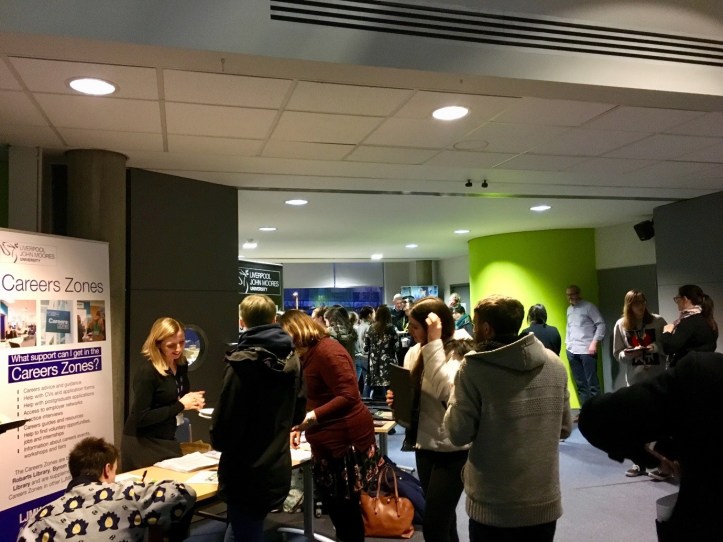
On Thursday 8th March around 50 students came along to hear from some excellent speakers about career options in the forensic anthropology and forensic science field. The guest speakers shared useful advice about breaking into careers in forensic anthropology, fingerprint and crime scene investigation, osteology, research and finally forensic pathology.
Firstly, we heard from Dr Julie Roberts, Scientific Lead and Team Leader at Cellmark Forensic Services. Cellmark provide the police with wide-ranging forensic casework services to support the investigation of criminal offences. They have forensic laboratories in Oxfordshire and Lancashire and deliver forensic services from the crime scene to court.
Julie started by outlining the role of forensic anthropologists and the types of cases they assist with. As experts in skeletal anatomy, duties include working with decomposed, skeletonised and burnt remains. This includes substance and species ID, fragment ID, interpretation of thermal damage, physical reconstruction and facial reconstruction. She often works in conjunction with archaeologists, pathologists, odontologists, radiographers, DNA scientists, isotope specialists, botanists, entomologist and soil scientists.
After an initial career in orthopaedic nursing, Julie gained a degree in Archaeology and Ancient History and an MSc in Osteology, Paleopathology and Funerary Archaeology. Through undertaking self-employed osteology and archaeology consultancy work for Glasgow University, she developed extensive expertise in examining cremated and unburnt bone, which eventually not only led to the offer of a permanent job with Glasgow University but also resulted in Julie being regularly asked for her assistance in homicide cases by the Department of Forensic Medicine and Science. Following a five-year spell as a forensic anthropologist/archaeologist at a private forensic laboratory in Oxford, Julie then moved to Cellmark to set up their forensic anthropology and archaeology service.
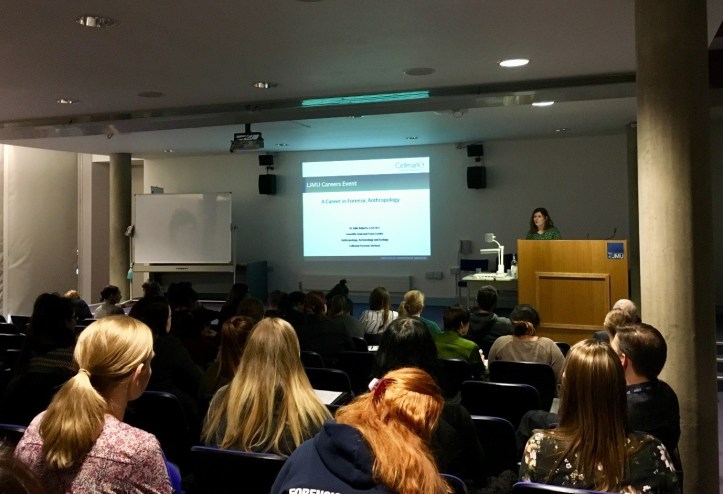
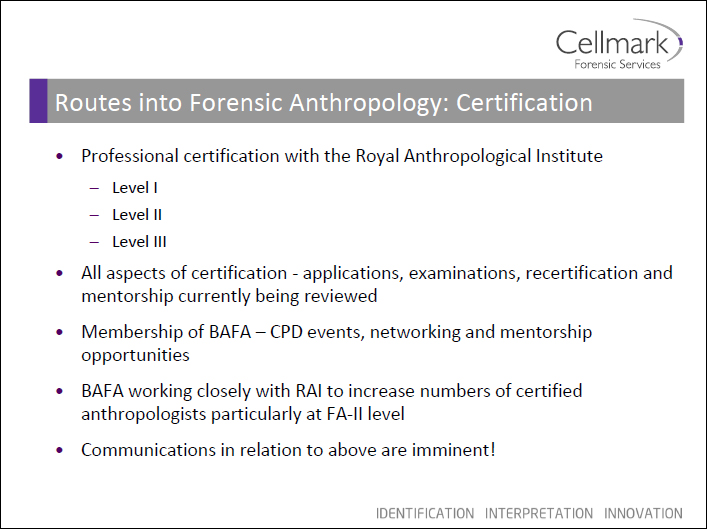
After impressing the audience with her varied and interesting career (Julie has lead on high profile investigations including the abduction and murder of April Jones in 2012 and the Shoreham Aircrash in 2015) she then explained the stages to becoming a forensic anthropologist, detailed below..

Finally Julie summed up by sharing her tops tips for students wanting to pursue this career route:
- Obtain a suitable qualification and know your subject matter!
- Get as much experience as you can working with skeletal remains. This does not have to be in a forensic context.
- Get as much experience as you can working with fragmented and cremated remains. Being able to identify small fragments of bone is an extremely useful skill. Knowledge of anatomical landmarks is vital for this.
- Any field or archaeological skills are also very useful (so take part in as many excavations as you can!), as are more niche skills such as facial reconstruction and image analysis.
- Don’t expect to walk into a job in forensic anthropology immediately after graduating. You may have to undertake some voluntary work and / or travel to obtain experience in forensic anthropology.
- You must be prepared to be flexible and perhaps get involved in peripheral work
- Attend conferences such as BAHID and BABAO, check websites for forthcoming conferences and training events
- There is a certain amount of luck – being in the right place at the right time and spotting opportunities
- Stay positive and don’t be put off by negative people!
Useful websites: www.cellmarkforensics.co.uk , www.bahid.org, https://www.therai.org.uk
Next up we heard from Phil Gilhooley an Independent Fingerprint Consultant. Phil has over 50 years’ experience in fingerprint and crime scene investigation, mostly with Merseyside Police. He started by giving us an account of his own career which started with an attempt to join the police as a police officer in the 1960s but unfortunately was not able to due to their height restrictions (thankfully they no longer have this!). Instead he joined the Fingerprint Bureau as an assistant fingerprint officer. Phil also told us about the varied cases he has worked on and then explained his progression into lecturing and finally private consultancy.
Phil then told us about some research he had done prior to attending our careers evening (what a great guy!). He had spoken to a number of LJMU graduates the week before on a visit to Cheshire Police.
The first example was Lauren, who graduated with a first class degree in Forensic Science and is now working at Cheshire Constabulary in their Forensic Laboratory. She said her placement year at Merseyside Police in their Forensic Lab had been a great stepping stone in terms of helping her to gain experience and relevant skills. He then told us about Melissa who graduated with a 2:1 in Forensic Anthropology and then completed a Masters in Forensic Osteology. During this, she volunteered with Cheshire Police in their Forensic Laboratory. After her masters she took an agency job as a Forensic Administrator which enabled her to get into the organisation and was then able to apply for more internal positions – eventually she landed the job of Forensic Laboratory Officer.
According to Phil to succeed in a career in this field you need to show you have a real passion for forensics. You can do this by trying to gain as much experience as possible and keeping your forensic knowledge current. His top tip would be to try and get into the Police in any relevant role be this administration or a support role, and even explore agency staffing opportunities. Once you are in the organisation, after 6 months you can then apply for internal jobs relevant to forensics.
Next up was Carla Burrell an Osteologist & Post-doctoral Researcher who currently works at LJMU in the Research Centre for Evolutionary Anthropology and Palaeoecology. Carla is an alumna of LJMU and studied Forensic Anthropology from 2009- 2012.
Carla talked about the volunteering experiences and work placements she undertook whilst studying at LJMU and encouraged all undergraduate students to do this to help them develop relevant skills and additional experiences to stand out from the crowd. Her experiences included a 4 week archaeological excavation in Bulgaria during and a 3 week internship with St. Mary’s University in Canada. During her time in Canada she had the opportunity to work alongside some of the world’s leading experts and assisted with autopsies, forensic bone cases, forensic photography and forensic facial reconstruction. She also did a 10 week work-based learning placement as part of her degree at Poulton Chapel.
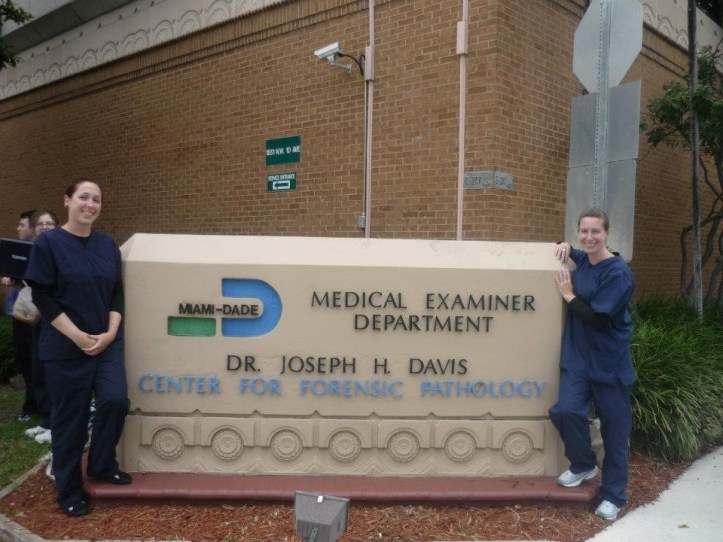

After her degree she applied for an Mphil with transfer to PhD at LJMU and her research focused on the Poulton and Gloucester Human Skeletal Collections. Her research has enabled her to present at events and conferences across the UK and internationally.
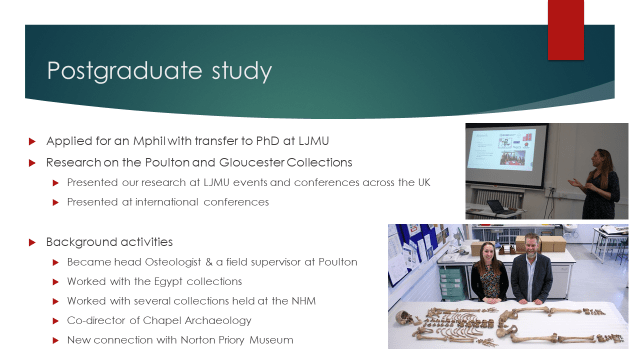
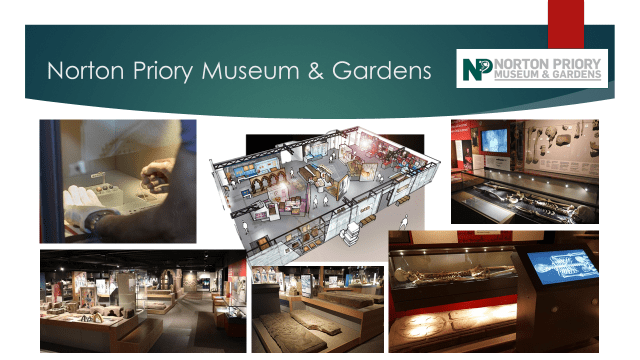
Carla really stressed the importance of volunteering and making connections. An important volunteering opportunity for Carla was with Norton Priory. Norton Priory is one of the most excavated monastic sites in Europe. The site includes the ruins of a 12th century Abbey, the standing remains of the 12th century undercroft as well as an 18th century Walled Garden just a stone throw away. The new museum displays thousands of artefacts from Norton’s 900 year history. Carla signed up to volunteer on the collections and met with the Senior Keeper to discuss her skills/knowledge and background with human skeletal remains. This led to progression for her research interests where she has been involved in the preparation of osteological reports for Norton and exploring Paget’s Disease of Bone in their human skeletal collection as part of her postdoctoral research. Carla now works alongside researchers from a number of universities across the UK and USA in order to learn more about the history of this disease which in turn helps research the current form of this disorder.
We then heard from the considerably experienced and highly regarded Dr Richard Shepherd. Dr Richard Shepherd is the leading forensic pathologist in the UK who has been involved in the investigation of many high profile deaths. He is a Visiting professor at City University London, Honorary Consultant at The Royal Liverpool Hospital and a registered UK Home Office Forensic Pathologist. With over 25 years of experience, he advised on the management of UK fatalities following 9/11, and was the forensic pathologist expert for the Bloody Sunday Inquiry and the death of Diana, Princess of Wales. He also appears on Channel Five’s Autopsy, where he investigates the mystery and intrigue behind the deaths of high profile celebrities such as Michael Jackson and Michael Hutchence.
Richard shared some insight into his own personal career outlining the path that needs to be taken to become a Forensic Pathologist – all in all about 13 years!

He explained that the only way to get into pathology is with a degree in medicine recognised by the General Medical Council (GMC). This usually takes five years to complete, although if you already have a degree in a subject other than medicine (usually a 2:1 or above), you can apply for a four-year accelerated medical graduate entry programme (GEP). Some medical schools accept degrees that are not necessarily in a science-related subject.
Your medical degree is followed by two years of foundation training, common to all medical graduates, where you work in a hospital as a junior doctor on a rotational basis in different departments, which may include a pathology specialty. On successful completion you’ll be awarded a Foundation Programme Certificate of Completion (FPCC).
Following foundation training, you’ll undergo further study in one of the four pathology specialities which takes around 5-6 years. For more information he recommended the following websites:
- https://www.themedicportal.com/application-guide/graduate-entry-medicine/
- https://www.gmc-uk.org/education/information_for_uk_students.asp
- https://www.bma.org.uk/advice/career/studying-medicine/becoming-a-doctor/graduate-and-foundation-students
- https://www.prospects.ac.uk/job-profiles/pathologist
If the average of 13 years training to become a pathologist has put you off Richard did outline another role you may be interested in, that of the Anatomical Pathology Technician (APT). One of the primary tasks is to assist and support Pathologists during post mortem examinations and reconstruction of the deceased afterwards. Anatomical Pathology Technologists can be based in an NHS Hospital Mortuary or a Local Authority Public Mortuary.
Typical duties include organising the day-to-day running of the mortuary facility, taking care of the personal belongings and effects of the deceased, being responsible for recording samples, specimens and organs and for their appropriate disposal; taking samples for clinical examination, transplant or research etc.
As an APT the extent of involvement during the post mortem examination varies depending on experience. A trainee in anatomical pathology technology would be expected to carry out basic tasks and would learn by shadowing and observing their mentor in the workplace. To become an APT you’ll need to complete a 2-year traineeship. As a trainee you’ll observe experienced pathologists and be expected to work towards the Level 3 Diploma in Anatomical Pathology Technology awarded by the Royal Society for Public Health (RSPH) as a minimum qualification.
Typical duties include organising the day-to-day running of the mortuary facility, taking care of the personal belongings and effects of the deceased, being responsible for recording samples, specimens and organs and for their appropriate disposal; taking samples for clinical examination, transplant or research etc.
There are not many training posts available but there are some each year, for more information about this career path Richard shared some useful links:
- http://www.aaptuk.org/link/apt-careers
- https://www.healthcareers.nhs.uk/Explore-roles/healthcare-science/roles-healthcare-science/life-sciences/anatomical-pathology
After hearing from our line-up of experienced and interesting speakers everyone then had a chance to network, chat to the employers and have a bite to eat!
If you were unable to attend the event and would like copies of the speakers slides just email the Careers Team: careersteam@ljmu.ac.uk
 LJMU Student Futures: Careers, Employability & Start-Up Team