
By Maureen Ouso
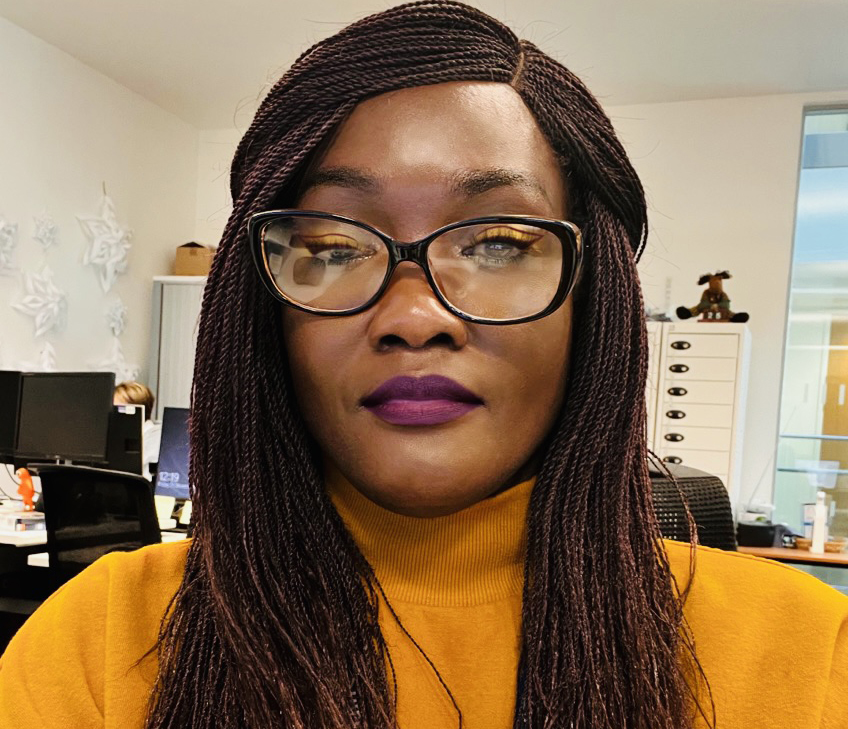
Maureen Ouso is currently working as a Trainee Faculty Administrator at the Liverpool Business School at Liverpool John Moores University, helping students to secure and manage their industrial placements. As part of the training, she also works with the Student Futures team for a day each week at the Student Life Building Careers Zone, helping the team to provide careers support for students as she works towards her level 6 Career Professional Development. Once complete, she will be able to further pursue a career in this sector.
This is a world away from where Maureen was 15 years ago in her home country of Kenya, East Africa. She was working in television and film production as a producer, her career was progressing nicely, and her goal was to direct a global blockbuster. It was then her life changed overnight …
It’s just one of those things, you know? One day you’re hale and hearty, life of the party, the next day you’re lying on a hospital bed on the verge of death and deafened. You can’t hear anything at all but your head is full of noise. A lot of buzzing, screeching and roaring, total bedlam, all taking turns to remind you that you can’t hear what’s going on outside of you. Your being. Like being reminded you’re an organism among other organisms and things. Things that make the world turn, that keep turning without your input, your hearing, your laughter, your health. And there’s life going on outside of you that you cannot be a part of. The worst part? There is absolutely nothing you can do about it. And I hate being in a position where I can’t do nothing about whatever is vexing me. So, you hold on to all the roaring and screeching and howling with hope. Hope that it’s all a bad dream and you’ll wake up back to your usual self. Hope that there must be a mistake and the doctors will sort your hearing out soon. You’ll soon be back on the dance floor, jiving to your favourite song, back at work, producing your yet to be favourite show, back to life, hearing your children’s laughter and quips. Will your kids soon call you mum when they come to visit you? Peering at you on your hospital bed in confusion, wondering what’s happening to you. Why you cannot suddenly hear them. If you’re really their mother or it’s some stranger impersonating you using an emaciated body. But you believe there’s hope. After all, it’s all you’ve got. Then again, to have hope, one must have an intrepid spirit. But it must be nurtured.
“Aaaaand it’s a wraaaaappp!”, my friend Isabelle, the Director yelled. We’d been filming in a location up country. The whole crew, including me cheered loudly and high fived each other. We couldn’t wait to get back to the city. Perhaps me more than anyone. My joints had been aching from the previous day and I had a pounding headache which wouldn’t abate. I just needed to get home to my children, have a warm bath and sleep for 48 hours straight. Away from all the buzzing mosquitoes and their stinging bites. We speedily packed up and got into our vans and drove homeward at whirlwind speed. In less than 3 hours I was home and groaning from discomfort despite taking painkillers. My house help got concerned and called a friend who rushed me to the nearest clinic. It was then I was diagnosed with severe malaria. At first, the doctor just gave me the usual medication for malaria (being a common illness in tropical areas) and sent me home. I spent a horrible night writhing and hallucinating due to high fevers. I was first in line at the same clinic the next morning. The doctor took one look at me and immediately ordered for me to be put on a drip of gentamycin and quinine. That was around 9 am. By 2pm, my kidneys had shut down and I was deafened. Never to regain my natural hearing. My dear mother, now deceased, promptly jetted into the country, and whisked me to a major hospital, ensuring I got the best treatment. I honestly can’t recall much from the first few weeks. I have both hazy and vivid recollections of my mother holding my hand and constantly caressing my forehead, waking up in the middle of the night to find her downing wine straight from the bottle, sponge bathing me, cleaning me up. It’s her soothing touch that I’ll never forget during those harrowing days.
But I got up. Eventually. My first steps out of that bed were a shock to me. I could not walk a straight line. I would take one step, and suddenly and involuntarily veer to the left or right, knocking down everything on my way – or out of my way. A major effect of hearing loss is loss of balance. I am still wobbly, and I cannot count the number of times I have been propositioned at 7 am by people who think I’m drunk. People would speak to me, but I couldn’t hear them. My mother got a notebook and pens for people to communicate with me. Some adults didn’t like it. Didn’t bother. They just kept moving their lips as if I would magically reach out and grab some form of hearing. But kids, especially mine, wrote to me. My son’s spelling improved greatly, and I realised my daughter was a good writer for her age. They were only 6 and 11 at the time, but such clever children. When I was discharged from Kenyatta hospital months later, I still had hope I would regain my hearing. Amid all these, I lost most of my household stuff and all my important documents due to a burglary. I can’t begin to explain to anyone how my hearing loss impacted my life and my children, but it wasn’t good. Misery and tribulation. They grappled with their own share of the burden and just thinking about it wrings me out to date. But, we are here now. Alive and trudging on. I had to face the fact that I now had no job, had to live with relatives, and undergo dialysis three times a week. This was an arduous pill for me to swallow and such a testing time. It wasn’t just me; it was my kids. I could see the desperation in their eyes, the weight on their shoulders, and the drag on their feet. They did not like it one bit and every single day was a heartbreakingly dismal day for us. We had an obdurate time living with relatives. Galling.
The first time I got an appointment to see a proper audiologist, I had hope. I was fitted for hearing aids and had to wait a couple of weeks for them to be ready. My mood was propitious. When the day finally arrived, I was up with the birds and anxiously waited to be escorted to the audiologists. Things didn’t pan out as expected. I learnt my natural hearing was all gone and not even the best aids would help. The cell hairs in my cochlear were dead.
“You don’t have to look so down. Your cousin lost a finger and is still getting on with life.” Those were the first ‘encouraging’ words I got. I am not sure why I can never forget them. I never got much support, so this was a blow. I was shattered, my mind pulverised. When my mother was informed, she quickly sent me a text telling me to have hope because I could have a cochlear implanted in the UK. My sweet mother. A month later, she passed on while preparing documents for me to come and get treatment in the UK. No one had told me she was unwell until a couple of weeks before her death because they didn’t want me to worry. Her cancer had returned. I only learnt of her illness a couple of weeks before her death. Devastation. My kids and I eventually came to the UK for her burial. The events that followed weren’t short of frenetic, but I won’t go into it. My disability glared at me. People would harm my kids and I would not be aware. My kids wouldn’t tell me thinking to protect me. I would get into heated verbal fights each time I thought someone was trying to or harming my kids. But I began to get support from outside of family. The support my kids and I needed. I joined lip reading classes, joined sign language classes, and renal support groups. When I first joined a sign language class, everyone was hearing except the teacher, who was deaf. It wasn’t easy at all for me. I could hardly follow what was going on. Even though I finished and passed BSL Level 1, once I got my implant, I repeated that level and was happy with my certificate this time round. I have since done up to Level 2. No easy feat. Of course, everyone still had to write to communicate with me. Some family members would read these one-sided conversations not bothering to respect my privacy and jump to conclusions. Most times I would be asked why I wasn’t participating in conversations, where the adults weren’t really bothering to include me. The only time I would feel comfort, or some relief was outside of the house. I used to go for dialysis 3 times a week and everyone there was so kind and would take time to ‘write’ to me, having long conversations. I also attended the various support groups whenever I could. There was this one time though, I was in hospital for some minor procedure. A nurse came to me and handed me a form on a board, which I couldn’t read clearly because of the medication I’d taken. She kept on talking and I kept repeating that I was deaf, and that she needed to write to me what was needed. The weird thing is that she was talking while looking away from me. I broke down. I was bawling like a baby. All the pent-up frustration rising to the surface. A different person came to my aid eventually. I calmed down enough to explain myself. An apology was proffered, and it was explained what was needed from me. I have had quite a few more enfeebling incidents since then, even with my Cochlear Implant, but I ride them out.
In 2012, more than four years after losing my hearing, I was finally offered the opportunity to get a Cochlear Implant. This is a magnet implanted behind your ear, that ‘acts’ as your cochlear. It has an outer aid called a processor, which captures sound and sends to the magnetic cochlear. I had to wait two weeks after surgery to be ‘switched on’. The wait was arduous. Even though I had been warned not to expect to hear much from the first day, I was restless with anticipation. The day finally dawned, and I was greatly disappointed. At first, during the switch on, I could hear sounds and even discern simple words without lip reading. Of course, the room was soundproof, and I was in tears hearing voices after years of deafness. The usual marauding noises (tinnitus) I always lived with were blotted out. Even though everything sounded different, robotic, squeaky, Mickey Mouseish, I was elated to be able to discern sound, words. Then came the part I was asked to walk around the hospital and try and make out what I could hear. I enthusiastically stood up and left to wander about. To my chagrin, I could hardly make out much but horrible noise. I couldn’t discern the words of those speaking around me. To say I was dismayed is an understatement. I kept thinking to myself, “What’s the point?”.
But the audiologists were very supportive and kept encouraging me. I was told I would begin to identify new sounds every day, and in a couple of months, speech would be easier. I needed to be patient and let my brain learn how to hear sounds with the Cochlear Implant, and not acoustically. They warned me that music and phones are the holy grails of implants. I had yearned to listen to music again, so all this was disappointing. It didn’t help much that on the way home, the person I was with kept nudging me to hear the music playing. All I could hear was noise, but he treated me like I was a fool, as if it was my fault. I was a sad woman who arrived home to my children eagerly waiting for me to hear their voices, calling me “mum”. Oh, the first few days were a conflation of comedy and farce…….and miscommunication. I would be upstairs and rush down thinking someone had called my name. It would turn out someone had just pulled a chair. Someone would shout my name and I would think someone was moving furniture. I would sometimes forget to wear my processor and leave home without it. Frankly, most times I couldn’t be bothered but my children kept reminding me to be patient. Not in so many words, but them being there reminded me that they were looking up to me. The doorbell would go off and I would think it’s the smoke alarm. You would be speaking to me, and I would totally get the wrong end of the stick. Most of them are too embarrassing to tell. The first sound I clearly heard and identified was the microwave. I can recall this because I will never hear the end of it. Trust my kids.
The microwave went off and I clearly heard and identified the ping. I was jumping up and down, screaming and telling everyone while pointing to the microwave, “I heard that! I heard that!” Tears. Joyful tears. Then this time I got into a taxi and the first song I identified was ‘My love is your love’ by Whitney Houston. And I went off telling the taxi driver while pointing to his radio tearfully, “I can hear that! I remember that! That’s Whitney Houston!” repeatedly. The poor guy was mortified but I eventually calmed down enough to explain to him why I was being a clown. As days went by, speech became apparent, but I always had to rely on lip reading. I went back to the audiologist for my mapping. This is where they play every tone for you, from the highest to the lowest and ask you what point you’re comfortable with. It takes a long time and is quite tedious but worth it in the end. I must have it done occasionally. After my first mapping, my lip-reading reliance was at 45% and 55% speech. It got better as days went by and I can now say it’s at 25% for lip reading and speech at 75%.
The effect of this life-changing experience on my career and employability was profound. Everything I was working toward went away in an instant. It took a long time to pick up the pieces and to get back on track. I do get more exhausted than the average person by the end of each day because I must unavoidably strain to hear in most environments, but I can tell you without a doubt, technology is amazing, and things get better every day. Support is also vital. I feel lucky to be here where my needs are fully supported and I’m so glad students at LJMU can benefit from this support too and hopefully go on to achieve their future goals.
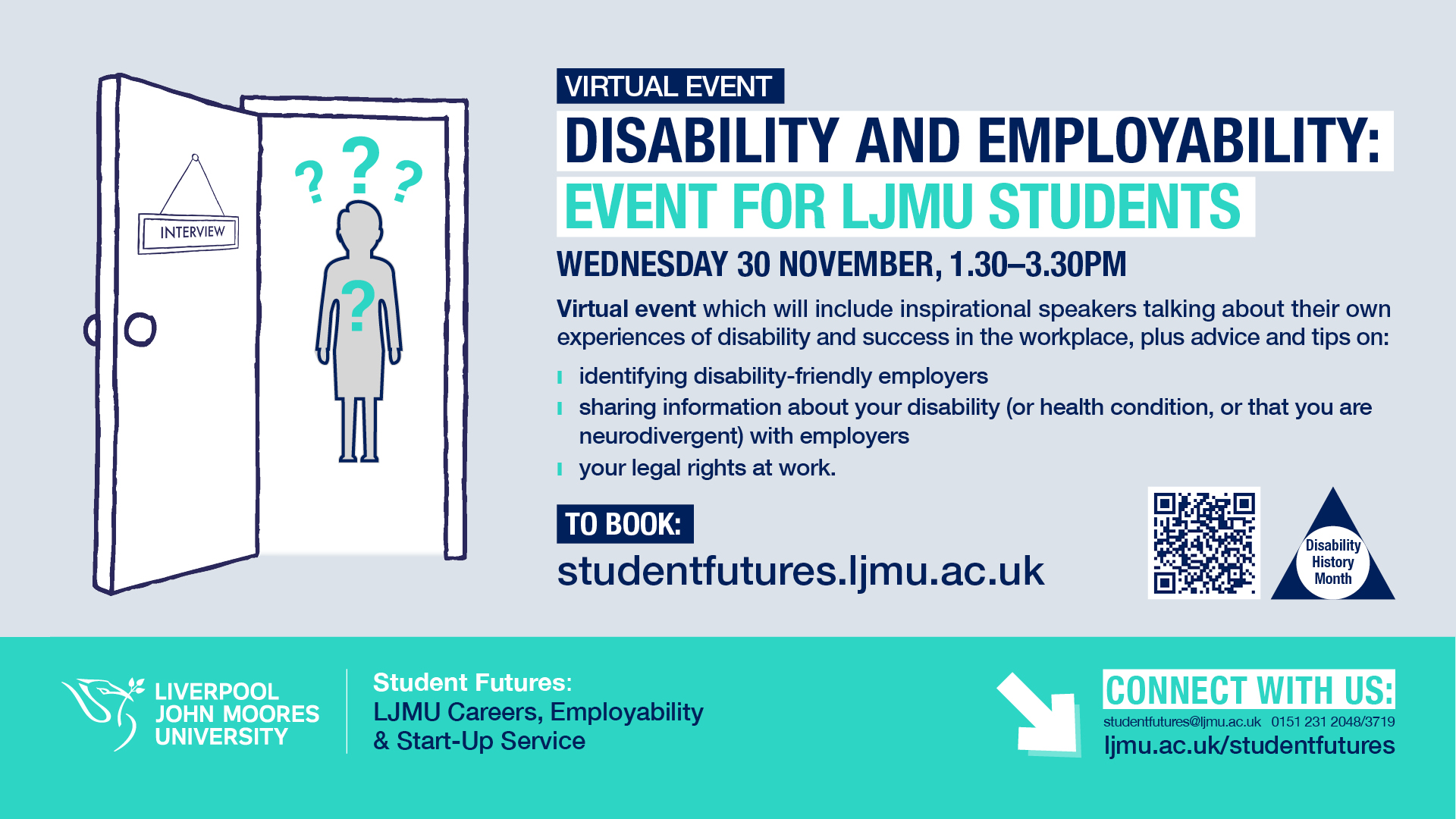
As part of Disability History Month, the Student Futures team are running a virtual session on Disability and Employability on Wednesday 30 November, from 1.30-3.30pm. The session, which is open to students from any programme or year group, will include inspirational speakers talking about their own experiences of disability and success in the workplace. The speakers are (subject to change):
- Jenny McLaughlin, Project Manager and Lead for the Disability Network at Heathrow
- Abigail Tennant, Assistant psychologist and well-being specialist at Lexxic, a leading neurodiversity consultancy
- Gemma Ellison, Director of Learning and Culture, the MAPD – ‘Making a Positive Difference’ – Group
There will also be information provided about rights in the workplace and what information you should share with an employer about your disability, health condition or about being neurodivergent. To book a place, click here.
 LJMU Student Futures: Careers, Employability & Start-Up Team